
Stylistic Preferences are not Objective Standards of Quality
Lessons from Country-Rap

Country singer, Jelly Roll cleaned up at the Grammys in January 2026. Clearly, Jelly Roll’s music has found a market and opened doors for future entertainers by blending music genres. Known as “country rap”, “hick-hop,” or “cross-country,” his music blends country with rap in a way that was once mocked by both fans of country and rap.
He isn’t the first to “Boot Scoot Boogie” across genres, as evidenced by Brooks & Dunn, who broke the country purist mold amid controversy in the 90s, or the Bellamy Brothers, who tried, only to see their streak of number one hits end in 1987 as their song “Country Rap” barely reached No. 31 on country radio. Equally skeptical of this genre-blending were rap artists and fans who viewed country music as the Appalachian antithesis of rap’s urban origins.
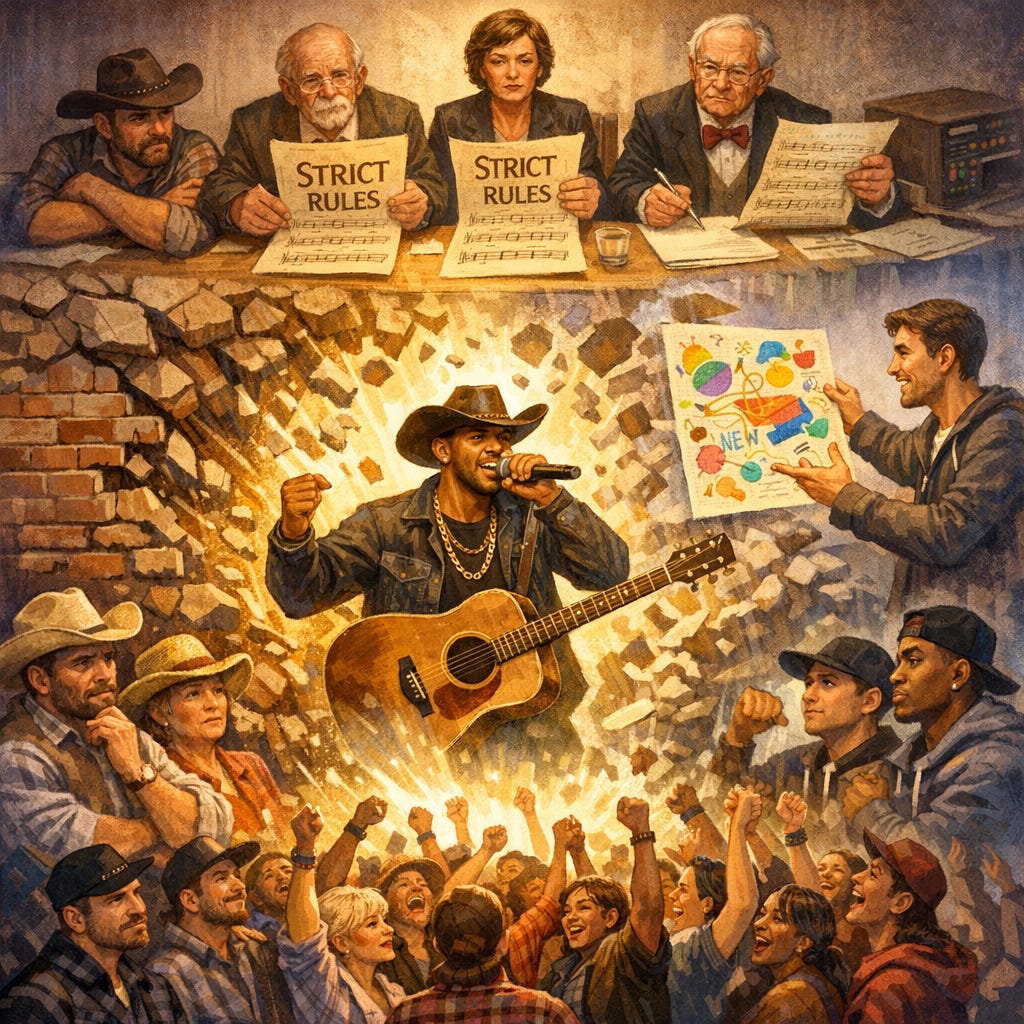
How the times have changed. Country–hip-hop fusions have spent 15 or more weeks at Number 1 on the Hot 100 over the last few years. Who would have ever thought that Lil Nas X’s 2019 “Old Town Road (Remix)” featuring Billy Ray Cyrus, renowned for his 90s country hit, “Achy Breaky Heart,” would not only kick down a door, but obliterate a divide that was once considered wider than the aisle between Republicans and Democrats?
Clearly, there can be opportunity and value in blending genres to create new categories, but while times have changed in country music, yesteryear is alive and well in the review process of many entrepreneurship, management, and organizational journals, with editors and reviewers sounding more like country music fans from the 1970s than from today.
Consider, for example, a theory paper I recently had rejected for not looking enough like other articles from that journal. Indeed, almost none of the feedback focused on the paper’s content, with the criticism focused on my structural and stylistic choices, not because they were bad or unjustified, but because they were not the norm. What unforgivable sins had this paper committed? '
It used fiction as inspiration,
it blended theories to raise questions, and
it did so creatively, such that it did not resemble the structure of most papers.
As a result, gatekeepers could not allow it to proceed, despite everyone agreeing that it had achieved its objective of generating highly valuable theoretical insights. Indeed, all three reviewers and the editor acknowledged its contributions, repeating them back to me as if they were their own ideas, while praising the paper’s writing and flow, but then the nitpicking started, questioning my stylistic choices, promoting the replacement of them with their own, and confusing their own more conservative preferences for objective standards of quality.
I realize that my angst can be dismissed as sour grapes, but before doing so, consider one comment that captured the sentiment of almost all the others. It still haunts me because it may foreshadow a bleak future for scholars like me who like to challenge structural norms. It focused on the length of my introduction, which numerous scholars had vetted for me before submission.
The problem? The introduction was more than three paragraphs long. Mind you, even Jay Barney, the champion of the three-paragraph introduction, explicitly states - more than once - in his 2018 AMR editorial that his advice is not meant to be an algorithm and that authors should use their judgment. However, with the advent of Large Language Models (LLMs), Barney’s advice is rapidly becoming dogma, enforced by self-righteous reviewers. What was intended as a guideline is applied by many until it becomes an LLM algorithm, enforced by gatekeepers. That algorithmic rule then becomes a norm used to communicate the legitimacy of new research, such that ensuring compliance with that norm becomes more important to gatekeepers than actual evidence of quality scholarship, clearly presented.
Just imagine this dialogue:
Editor and reviewers: This is an amazing song that draws on both country and rap, but we’re only interested in a good country song.
Author: The song is great because it deviates from the structure of the typical country song. It draws heavily on the structure of a rap song while retaining the melodies characteristic of a country song, creating a new category: country rap.
Editor and reviewers: We like the new category and agree that the song is different and great because of it. However, this does not sound like a country song. You might want to use Trace Adkins’s “Honky Tonk Badonkadonk” as an exemplar and rewrite the song. Also, everyone knows that a country song starts with four verses before the chorus. Yours started with the chorus. That was great, but you need to fix it. A country song should start with four verses.
Author: Ugh! Seriously?! “Honky Tonk Badonkadonk” is an assault on my eardrums. “Come on, Billy Ray, maybe the Rap industry wants a piece of this new genre? Lil’ Nas X out!”
It is no wonder our papers still sound more like the simple song structure of a George Jones hit from the 1970s than the innovative, diverse hits of today’s country music. To paraphrase another old country song, “Take this [3 paragraph intro] and shove it!”
to “Boot Scoot Boogie” across genres, as evidenced by Brooks & Dunn, who broke the country purist mold amid controversy in the 90s, or the Bellamy Brothers, who tried, only to see their streak of number one hits end in 1987 as their song “Country Rap” barely reached No. 31 on country radio. Equally skeptical of this genre-blending were rap artists and fans who viewed country music as the Appalachian antithesis of rap’s urban origins.
How the times have changed. Country–hip-hop fusions have spent 15 or more weeks at Number 1 on the Hot 100 over the last few years. Who would have ever thought that Lil Nas X’s 2019 “Old Town Road (Remix)” featuring Billy Ray Cyrus, renowned for his 90s country hit, “Achy Breaky Heart,” would not only kick down a door, but obliterate a divide that was once considered wider than the aisle between Republicans and Democrats?
Clearly, there can be opportunity and value in blending genres to create new categories, but while times have changed in country music, yesteryear is alive and well in the review process of many entrepreneurship, management, and organizational journals, with editors and reviewers sounding more like country music fans from the 1970s than from today.
Consider, for example, a theory paper I recently had rejected for not looking enough like other articles from that journal. Indeed, almost none of the feedback focused on the paper’s content, with the criticism focused on my structural and stylistic choices, not because they were bad or unjustified, but because they were not the norm. What unforgivable sins had this paper committed? '
It used fiction as inspiration,
it blended theories to raise questions, and
it did so creatively, such that it did not resemble the structure of most papers.
As a result, gatekeepers could not allow it to proceed, despite everyone agreeing that it had achieved its objective of generating highly valuable theoretical insights. Indeed, all three reviewers and the editor acknowledged its contributions, repeating them back to me as if they were their own ideas, while praising the paper’s writing and flow, but then the nitpicking started, questioning my stylistic choices, promoting the replacement of them with their own, and confusing their own more conservative preferences for objective standards of quality.
I realize that my angst can be dismissed as sour grapes, but before doing so, consider one comment that captured the sentiment of almost all the others. It still haunts me because it may foreshadow a bleak future for scholars like me who like to challenge structural norms. It focused on the length of my introduction, which numerous scholars had vetted for me before submission.
The problem? The introduction was more than three paragraphs long. Mind you, even Jay Barney, the champion of the three-paragraph introduction, explicitly states - more than once - in his 2018 AMR editorial that his advice is not meant to be an algorithm and that authors should use their judgment. However, with the advent of Large Language Models (LLMs), Barney’s advice is rapidly becoming dogma, enforced by self-righteous reviewers. What was intended as a guideline is applied by many until it becomes an LLM algorithm, enforced by gatekeepers. That algorithmic rule then becomes a norm used to communicate the legitimacy of new research, such that ensuring compliance with that norm becomes more important to gatekeepers than actual evidence of quality scholarship, clearly presented.
Just imagine this dialogue:
Editor and reviewers: This is an amazing song that draws on both country and rap, but we’re only interested in a good country song.
Author: The song is great because it deviates from the structure of the typical country song. It draws heavily on the structure of a rap song while retaining the melodies characteristic of a country song, creating a new category: country rap.
Editor and reviewers: We like the new category and agree that the song is different and great because of it. However, this does not sound like a country song. You might want to use Trace Adkins’s “Honky Tonk Badonkadonk” as an exemplar and rewrite the song. Also, everyone knows that a country song starts with four verses before the chorus. Yours started with the chorus. That was great, but you need to fix it. A country song should start with four verses.
Author: Ugh! Seriously?! “Honky Tonk Badonkadonk” is an assault on my eardrums. “Come on, Billy Ray, maybe the Rap industry wants a piece of this new genre? Lil’ Nas X out!”
It is no wonder our papers still sound more like the simple song structure of a George Jones hit from the 1970s than the innovative, diverse hits of today’s country music. To paraphrase another old country song, “Take this [3 paragraph intro] and shove it!”
 | A guest post by
|